
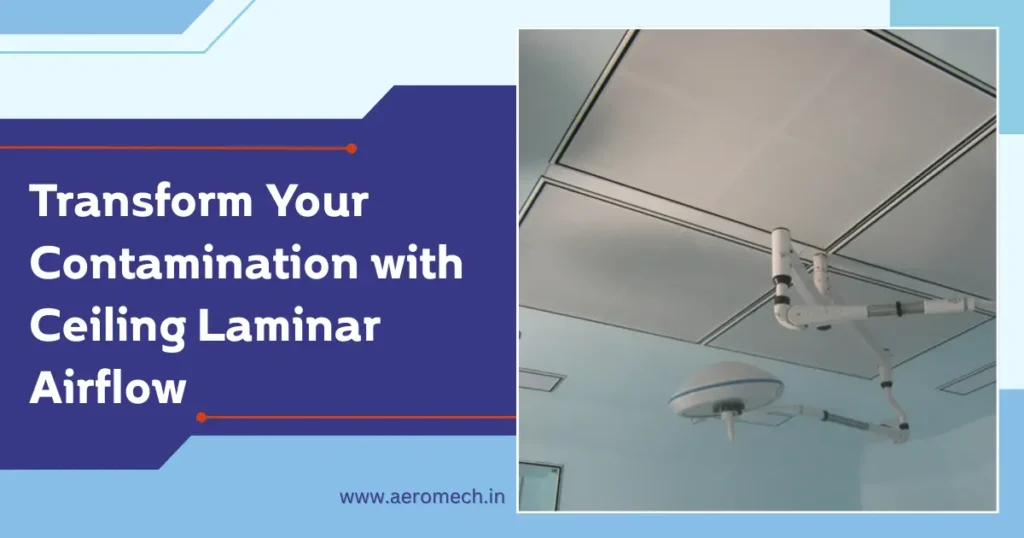
In the high-stakes world of sterile manufacturing, contamination isn’t just a quality issue—it’s a business-threatening crisis that can destroy entire production batches, trigger regulatory warnings, and damage brand reputation. Ceiling laminar airflow systems represent the gold standard in contamination control, but not all systems deliver on their promises. Here’s your complete guide to understanding what actually works.
What Makes Laminar Airflow “Actually Work”?
True laminar flow isn’t simply moving air—it’s creating unidirectional, parallel air streams that move at uniform velocity without turbulence. This precision-engineered airflow continuously sweeps particles away from critical work areas, preventing contamination from settling on products, surfaces, or equipment.
The three pillars of effective laminar flow:
- Unidirectional downflow creating a protective air curtain
- 99.995% filtration efficiency removing particles to 0.3 microns
- Consistent velocity maintenance ensuring continuous protection
HEPA vs. ULPA: Understanding Filtration Excellence
HEPA filters (High-Efficiency Particulate Air) capture 99.97% of particles at 0.3 microns, meeting most pharmaceutical and medical device requirements. ULPA (Ultra-Low Penetration Air) filters achieve 99.995% efficiency, providing the ultimate protection for semiconductor, nanotechnology, and critical drug manufacturing applications.
The 0.3-micron standard isn’t arbitrary—it represents the most penetrating particle size, making it the hardest to capture. Filters performing at this level effectively capture both larger and smaller particles with even greater efficiency.
The Engineering Behind Unidirectional Flow
Ceiling-mounted laminar flow systems create a vertical air cascade that functions like an invisible protective umbrella over work surfaces. Unlike turbulent airflow that swirls and potentially redistributes contaminants, unidirectional flow ensures particles move in one direction only: down and away.
Critical design elements include:
- Full-ceiling coverage eliminating unprotected zones
- Uniform velocity distribution preventing dead spots
- Positive pressurization blocking external contamination ingress
- Continuous air exchange maintaining sterile conditions
Microprocessor Control: The Intelligence Factor
Modern systems incorporate sophisticated control systems that actively monitor and adjust performance in real-time. Microprocessor-based controllers track:
- Airflow velocity maintaining optimal protection levels
- Filter loading predicting maintenance requirements
- Pressure differentials ensuring proper contamination barriers
- System anomalies triggering audio/visual alarms
Magnehelic gauges provide visual confirmation of filter condition, enabling proactive maintenance before performance degradation compromises sterility.
Fixed vs. Transportable: Choosing Your Configuration
Fixed installations with eye bolts and drop rods offer permanent protection for dedicated production areas. These systems provide maximum stability and seamless integration with cleanroom architecture.
Transportable units on movable supports deliver flexible contamination control, enabling manufacturers to create temporary aseptic zones wherever needed. This versatility proves invaluable for multi-product facilities and campaign manufacturing operations.
The Modular Advantage: Scalability and Maintenance
Modular design revolutionizes both installation and upkeep. Pre-assembled components reduce installation time by 50-70% compared to custom-built systems, while tool-free access panels simplify filter replacement and cleaning.
Modular benefits include:
- Rapid deployment minimizing production downtime
- Easy expansion accommodating facility growth
- Simplified maintenance reducing labor costs
- Component standardization ensuring consistent performance
Energy Efficiency Without Compromise
Traditional concerns about laminar flow energy consumption have been addressed through intelligent design innovations. Teardrop-shaped lighting fixtures positioned outside the airflow zone eliminate heat generation within the sterile field, while energy-efficient fan motors reduce electrical consumption without sacrificing performance.
Applications Across Industries
Pharmaceutical manufacturing leads adoption, where GMP compliance mandates documented contamination control. Biotechnology labs require protection for sensitive cell cultures and research materials. Food processing facilities use laminar flow for premium product manufacturing. Medical device manufacturers depend on it for implantable device production. Even cosmetic producers recognize the quality advantage laminar airflow provides.
The Real-World Performance Test
Systems that actually work demonstrate measurable results:
- Consistent ISO Class 5 performance in operational conditions
- Zero contamination events during validated production
- Regulatory audit success without airflow-related findings
- Long-term reliability exceeding 10+ years with proper maintenance
Making the Right Investment
Industry-leading specialists like Aeromech understand that effective laminar airflow systems require precision engineering, quality components, and expert installation. Their modular, microprocessor-controlled units deliver the reliable performance that transforms contamination control from a concern into a competitive advantage.
The difference between systems that work and those that don’t often comes down to engineering excellence and manufacturing quality—investments that protect your most valuable asset: product integrity.